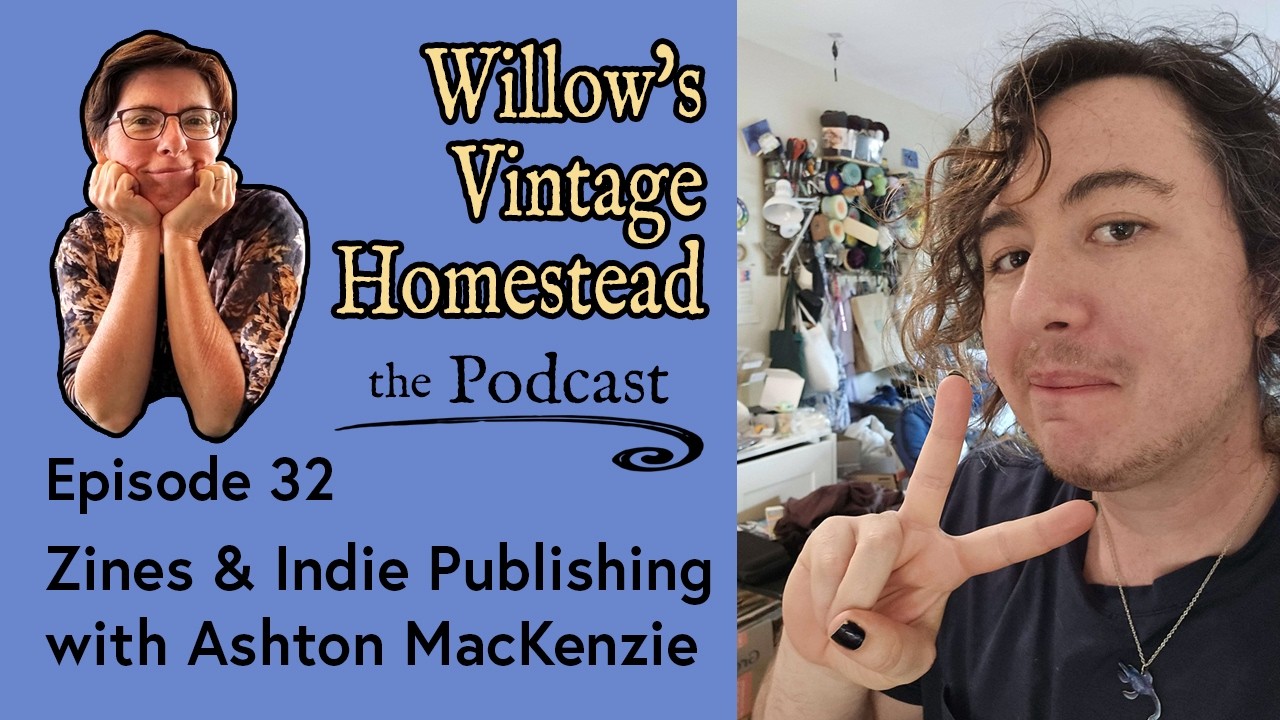
Earlier this year I had the lovely opportunity to chat with Willow Polson about one of my favorite topics- Zines!
In this episode of Willow’s Vintage Homestead, host Willow Polson talks with me about zines: what they are, where they came from, and why people continue to make them. Our conversation follows the format I often use when teaching my zine workshops: placing zines within a much longer historical context of people using whatever publishing technology they can access to circulate ideas, preserve experiences, and find one another outside the institutions that usually decide what is worth printing – and by extension, whose perspectives and lives are valued.
Episode Summary
The discussion begins with the history of print itself. Willow and I trace part of the zine’s ancestry back to the development of movable type separately in China and, closer to my expertise, the Gutenberg press (3:47–5:26). Printing makes it possible to reproduce written material on a scale that handwritten copying cannot not easily match. Over time, cheaper and more accessible forms of printing allowed political and religious arguments, practical information, and personal works to be accessible to a wider audience. We see a more and more literate population, as well as inspiration and confidence in that same population to write about themselves, or in conversation with established power entities.
Historical pamphlets occupied a role that is recognizably similar to the one zines often occupy today. Thomas Paine’s Common Sense, for example, used an inexpensive and relatively compact form to make a political argument available to a wide public and help galvanize support for the American Revolution (6:08–6:39). The modern word zine had not yet been invented, but the underlying impulse was already present: someone has something they believe people need to read, and they find a way to put it into circulation without waiting for the approval of a major publisher.
We then follow that impulse into the twentieth century, when fan communities began producing their own publications. Science-fiction and fandom zines, including the fan writing and artwork that developed around Star Trek, gave people a place to participate actively in the stories and communities they loved (7:11–8:46). Readers could become writers, critics, illustrators, editors, and correspondents. A person did not need to be invited into the official publishing industry before they could make something and send it to others who cared about the same things.
At the same time, zines and independent publishing are also important to the civil rights movement. Black Panthers and other Black publications work to connect a Black and equality-interested readership, as well as drive support for worker’s rights and women’s rights.
The shortened term zine became especially visible during the 1980s. We discuss the importance of zines within queer communities, including their use for circulating urgently needed information during the HIV/AIDS crisis (2:57–3:24). When mainstream institutions ignored queer people, misunderstood them, or treated their lives as unfit for public discussion, independently produced publications could carry information directly through the communities that needed it. Zines helped people share political analysis, health information, art, personal testimony, contact information, and the knowledge that they were not alone.
This history also makes the changing technology of zine production important. Early creators might use mimeograph machines, which required substantial physical work and preparation to produce even a modest number of copies. Later, access to office Xerox machines made it possible to assemble pages from typed text, handwriting, drawings, photographs, and clippings, then reproduce the finished object much more quickly (10:48–12:44). People used the machines available through workplaces, schools, libraries, community organizations, and copy shops, sometimes with permission and sometimes by sneaking in after-hours or between work tasks.
Each technological change alters what zinesters can publish, but the culture surrounding zines remains grounded in resourcefulness. Zinesters learned how to work within the limitations of the tools they could reach, and each time push the boundaries of their publishing medium. Zines are reduced, enlarged, cut, pasted, folded, stapled, and copied. Production value varies – zines often don’t consider resembling commercially printed magazine to be meaningful. A zine’s visible construction often becomes part of its identity, carrying evidence of the hands, machines, and circumstances that produced it.
That material quality is part of what separates zines from publishing that is primarily organized around scale and profit. Zines are often made because their creators care intensely about a subject, want to record an experience, or hope to reach a relatively small group of people who will also share the zinester’s passion. Zines often don’t have traditional subscription or distribution networks. These days, a zine might travel through the mail, appear on a library shelf, sit on a table at a show, pass between friends, or be exchanged for another zine. Audience success does not necessarily depend on reaching thousands of readers. Often the important outcome is that a zine reaches the particular person who needed to encounter it.
Throughout the conversation, Willow and I return to this relationship between zines and organic community building. A zine can introduce people who would otherwise never meet. Zines can preserve a local history that no established publisher is likely to record. Zines often preserve a personal story before that story disappears from collective memory. Making a zine can also allow a person to speak while they are still working out exactly what they think, without requiring the finished authority associated with a book or formal article (9:50–10:10, 21:24–22:09).
For anyone interested in making a zine, I describe an especially accessible format: a small four-page zine made from a single sheet of paper (22:23–23:15). In classes in-person, I’ll often go over this and an eight-page zine, but for a podcast audio format where we were running out of time, the four page zine is great because it’s one of the most accessible and appropriate for all skill levels.
The episode also considers what happens to zines after their first readers have encountered them. Small publications are especially vulnerable to being lost because they may exist in limited numbers and circulate through informal networks. Willow and I also discussed ways of finding and preserving them through local libraries, personal collections, online archives, web rings, and resources such as the Internet Archive (25:35–28:10). Digital preservation can give a fragile publication a longer life, although the physical object still carries qualities that a scanned page cannot reproduce completely: the paper, the folding, the print texture, and the choices involved in assembling it.
It was a great experience to get to chat with Willow and I hope to be a guest on Willow’s Vintage Homestead again in the future.
If you love history, traditional arts and skills, and vintage living as much as I do, come join me here at the Homestead, where the conversations are always interesting and educational.
I’m glad you’re here.
Hello everybody.
Welcome to Willow’s Vintage Homestead, where we talk about all manner of oldtimey topics.
I’m your host, Willow Pollson, and with me today is Ashton McKenzie, who knows quite a bit about Zen and indie publishing.
And I’m interested to get into that, not only the history of it, but how maybe you could publish something yourself if you were so inclined.
How are you doing?
I’m happy to be here today.
Thank you for having me, Milo.
Yeah, absolutely.
I thought this was a really unique topic.
So, what got you interested in Zen?
And well, I mean, indie publishing that’s just sort of the small version of larger publishing.
Zen are a whole thing like a sub genre.
Yeah.
So there’s various subcultures associated with Z.
For people who aren’t familiar with uh what Z refer to, they’re like small magazines, which is why they just sort of took Zen out of magazine and it became like kind of like a quick way to talk about it.
Yeah.
People are always looking for ways to shorten words.
Exactly.
Exactly.
And then it becomes kind of like an ingroup thing like if you are in the no like maybe you run a Zen you become like a Zenster and that like is somebody who like runs a Zen or distributes one or is like otherwise involved in the production of these small things and like you know you talk to a lot of people who were there for what and this is not a term that is like generally accepted right but like I talk about it in terms of like some of the earlier waves of Zen culture in the 1900s, which makes everything sound super old.
I know, right?
I was born in the 1900s.
So was I.
Yeah.
Back in my day.
And and so like a lot of times people would call them like leaflets or pamphlets or something like that.
And they didn’t really like even if a Zen kind of got a little bit more mainstream attention, people were calling it more like a leaflet or a pamphlet or like a digest or something like that, they weren’t necessarily calling it a Zen.
So, like I would talk to people who, you know, are boomers and were definitely there and I’d be like, “Hey, check out this Zen that I found in the archives and I like printed it out and and bound it just the way it was before.”
And they’re like, “Oh, this is like a cool leaflet.”
I’m like, “You were there and they didn’t call it a Zen.”
And I guess that’s like a newer term, right?
Or like it’s a more um subculture term.
Yeah, I think so.
Um I have started hearing about them I guess in the 80s I want to say that is yeah so when I teach my zen class typically it’s like a free class or by don by by donation and I’m typically doing it in like libraries and stuff like that right I’m drawing this connection between the written word and who is in power and zen’s really taking off in the ‘8s and like that particular term and that subculture comes out of queer culture It’s in the 80s.
People needed a way to share information about their experiences and how to combat this new illness, this HIV thing going around.
Oh, okay.
So, basically, you know, Z have always been somewhat political in this way and they exist in this space of like we’re going to publish the things that the people with money and interests don’t want us to publish.
Okay.
I’m thinking also of uh like indie comics in the 60s and 70s that whole counterculture thing.
Yes, that is also a huge part of it.
Right.
So like the way I I teach this class is I go like hey do you guys know about the first printing press the Gutenberg press because before that all the books had to be written by hand and copied up by hand and they were made on parchment that it t is incredibly labor intensive to make.
you may or may not have already covered how to make like paper or parchment on the Homestead channel.
It’s incredibly labor intensive, right?
And also like you have to invest a lot of time and energy into teaching somebody how to write and then they have to sit there and copy it all out by hand which is why like you know you have these monasteries and educated people are really in direct control of like what books get made, right?
And we have this really low literacy rate.
Fast forward, the Gutenberg press significantly levels this playing field.
Now we’ve got what you might call like the middle class.
Like instead of the nobility and like the upper echelons of whatever religious order cuz you know the the the Chinese also had movable type, but I’m less familiar with how that affected the um Oh, really?
social.
Yes, they actually came up with movable type before the Europeans did.
Oh, wow.
I did not know that.
Yep.
It’s really cool.
and letter press like printing where you have like you know the type all all of your letters and they’re in a case and it’s great.
It takes so much effort out of making a book because like you arrange all the type on a page and then you can print as many copies of that page as you want.
Yep.
Still super labor intensive but way less than before.
Right.
So, right after the Gutenberg press hits the scene, we get a lot of people publishing stuff that the European Church doesn’t like and we get a lot of new philosophical movements like towards the Enlightenment and stuff like that.
You’ll note that the American Revolutionary War kind of started in American print shops like Ben Franklin and Thomas Payne, right, were also part of the publishing industry in Movable Type.
like Ben Franklin’s brother ran a newspaper or something like that and he uh wrote all these letters to his brother’s paper under this like fake name and yeah and like his brother was publishing them.
Thomas Payne’s um common sense is what I would call a Zen, right?
It’s a little book.
I’ve seen copies of it.
It’s, you know, it’s smaller than a normal size book.
And, you know, he published it, I believe, himself, but don’t quote me on that because I haven’t looked into like the details in a really long time.
But every student in the United States as part of our civics history classes learn that Thomas Payne writes this and it really galvanizes the amount of support that was needed in order to pull off the revolution.
Right?
So this is this is how I start teaching children about how advancements in publishing technology mean that it’s easier and easier for people with controversial or counterculture or what you know whatever the powers that be don’t want to publish any increases the access to publish means that more of these things do get published right and so when we talk about Zen in, you know, the 1900s, the early 1900s, the earliest fan zenes, and this is also where the term Zen comes from, is it’s from fandom culture, were mimograph printed.
And that is you go to a print shop, they actually make a stencil of every page that you want to have, and then they do like a run of that zen, and like depending on the print shop, they may or may not keep the stencils or give them to you.
so that way you can do another run sometime.
I have a copy of of Spockanelia that I got off of the internet archive and it’s like 100 pages long.
So this would have been a full size like 8 and 1/2 by 11 in paper mimograph printed.
There’s beautiful fan art in it.
And yeah, and I reimpose that’s the part where you’re like rearranging the pages so that way when you you print it out if you’re going to bind it, all the pages end up in order in folios.
Yeah.
Yeah.
So, I didn’t really want to spend a hundred sheets of paper on something that I wasn’t going to be like like I really wanted to carry this around as like a classroom thing, right?
cuz I wanted to say like this is an example of an older zen and like I bring in the fan zen culture because for like the ’60s $2 $3 is a lot of money, right?
And that’s what each of these fanzines cost but they were almost losing money on printing these cuz that’s how expensive mimograph printing is.
Right.
Right.
And these people are what keeps Star Trek on the air and Star Trek was a hugely progressive show for its time.
Right.
people who do independent publishing, even at these smaller scales, can have this outsiz influence on mainstream culture because that’s what the written word allows us to do.
It allows us to share ideas and sort of align around like this cultural concept.
Oh, definitely.
Yeah.
Yeah.
I remember all of the little handdrawn and hand typed and Exactly.
newsletters from well and from al speaking of alternate communities I mean the earth religionists the uh the pagans you know the Wiccans and stuff had loads and loads of different little little zenes and you would subscribe and it would be just the cost basically of mailing and printing the thing but it was very very homegrown I mean especially in the 60s7s there’s tons of even books would have like all these funky line drawings of frolicking maidens in the wheat and stuff you know I meaners wouldn’t really be into.
Yeah.
And that’s what I love about this type of publishing so much is that because market success is not defined in terms of like volume sold and profit.
It’s so much more about we who are making this thing are really passionate about this topic and we hope that we find an audience who is just as passionate about it as we are.
It’s very personal and organic.
Yes.
And it allows for that more specific art styles, that funky cool or and you know, there’s also this varying production quality to your to your point there.
Like you know, a lot of people really do like the the sort of rough around the edges thing.
And then there’s an accessibility issue to that too where like the crunchier it gets, the harder it is to read.
But, you know, and is a great term for some of these.
They’re very crunchy.
Exactly.
And that crunch is actually a lot of times introduced by copy machines.
But they were really good because mimographic is expensive.
I tell people about the Xerox machines and then I introduced to them how to how to make their own.
Right.
Xerox machines were originally pretty expensive and typically only businesses had them.
Yes.
But you’ll start seeing in Zen in like the late 70s, in the 80s, in the editor’s notes, that they are sneaking into their places of work after hours to run these scenes.
And sometimes they’re bringing their own paper, but sometimes they are literally stealing the paper from work, too.
And there’s discussions that happen between people associated with the Zen that get published in some of the longer Zenes and they’re talking about, you know, maybe somebody’s literally doing it between tasks at work and these are older machines.
This is when the technology is new.
One of my favorite ones, and I believe that this was in a Star Trek ve scene, and I cannot remember which one at this moment, but someone is relating the story of a run of of Star Trek scenes or whatever they’re printing getting stuck, jammed in the copier.
Again, new technology, so they have to call it.
Oh, no.
And just a warning to anybody who goes and looks up some of these older zenes, especially for the origination of of the concept of slash or we don’t want to get too far down that rabbit hole, but it’s basically relationships between uh characters on a show that is not canon and we’ll just leave it there.
Yeah, it could get quite explicit, right?
And so like not only do you not want to be caught using company property for non-co company uses, you definitely don’t want to be caught printing scenes depicting these characters in this way or dispensing information about AIDS.
There’s a ton of things that people didn’t want to publish and people are sneaking in to work and publishing these things anyway.
So that really explodes it, right?
Like you get it takes off as copy machines become more accessible to people in print shots and stuff like that because instead of being like $2, $3 per Zen, it can get even cheaper and formats start showing up where like it’s a single paper.
So that way you can go with your friend and you want to like make a copy of the Zen, you unfold the Zen, throw it in the copy machine, a new one comes out, now you both have a copy of a Zen.
Ah, okay.
The zen piracy becomes kind of its own thing cuz there are like a lot of people who put a lot of effort into their zenes and wanted to make enough in order to continue making issues.
They don’t necessarily need to be making New York Times profit, but like they need they need, you know, something to cover their operational expenses at least.
And pirates are kind of eating into that.
So that becomes like another issue, but it’s a countercultural thing.
So there’s another thing of like Zen for Zen and Zen should be free and it’s an ongoing debate even today.
Oh, okay.
Well, yeah, let’s speak about today because obviously the internet, anybody with a computer can barf something onto the internet and there it is forever.
But yeah, so what how has that changed the the Zen scene?
We are having a moment.
I’ve been in several art stores over the last couple of years because I teach arts classes on the side and art stores are now stocking bookmaking supplies and running out of them because people are buying it.
Zi are clearly having a moment which I love because one of the things I like just as much as making Z is collecting them and the more people we get making Zen the more there are for me to collect.
It’s always so self- serving really.
Oh yes, it’s not entirely altruistic, but like it does create some social value.
So we we see that people are looking to bind their own books and publish their own books independently or they’re like downloading fanfiction or other things off the internet of project and they’re like binding their own hard copies of books.
Right.
Well, so some of that stuff is ephemeral because especially if it’s adult materials, uh yeah, it may or may not survive.
Right.
right?
It may or may not survive and there is this impetus and drive to archive things and like Zen themselves has also somewhat ephemeral because they are the kind of material that people don’t want to publish so they don’t always survive and to add to the discussion of like or allude to the discussion of piracy like the only reason why we have you know copies of Shakespeare’s plays is because of pirates in the audience and the only reason why we have some of these scenes today is because either people were hoarding them in their basement and and uploaded them to internet archive or other forms of piracy or backing it up or you know whatever you want to call it.
Um, right.
Yeah, there’s Well, so okay, I’m probably asking a loaded question here, but since you collect these things, would you consider chick trackcts to be z and do you collect them?
I don’t collect tick tracks for obvious reasons.
Now, for people who don’t know what I’m talking about, they’re a little Well, why don’t you explain what that is?
So, I have limited experience with them.
I saw them I saw them briefly online.
I don’t even remember what the context was that I ended up on this page explaining what they were.
A lot of them are very religiously oriented.
Oh, they’re all completely religious.
Basically, you know, if you smoke a cigarette, you’re going to hell kind of a thing.
Yeah.
Yeah.
And I belong to a number of the demographics that are somewhat demonized in these.
They’re not in my personal collection because right yeah for the most part I collect things that I want to read.
I do have some things in my Zen archive that are very long political zenes that I don’t fully agree with.
Okay, there’s one that I have and I have the box next to me, but I don’t necessarily want to spend the time to dig through it and pull it out.
and it’s discussing whether or not unions are too much the man and I am a card carrying union member.
Okay.
So it’s like okay it’s it’s something that makes me think.
Right.
Oh well see that’s important right there then.
Exactly.
Right.
Whereas the chick tracks just make me feel bad.
Yeah.
Once you think Yeah.
And then to to explain a little more, I mean, I I’m a little older than you and and I used to find them on buses and things and they’re these little like horizontal uh rectangular little leaflets, you know, like as I mentioned before that you know if you do anything basically kind of anything you’re you’re going to hell.
So and they were very very you just find them everywhere and they were both vilified and you know just spread to the four winds and that’s something that I don’t think really is the case with most zi you don’t just find them like scattered all over the place on a bus or something right yeah the distribution methods around z have evolved so like to talk about where I find them these days I find them a lot in coffee shops uh there’s frequently like a little table where people can put like their business cards or whatever in like a like an independent coffee shop.
I don’t mean like Starbucks or something like that.
Like the man does not like Zen.
So, but like you know your local we roasted it here crunchy coffee shop probably has like a place where there’s leaflets, right?
And so Z will be there if uh somebody’s just distributing them for free.
In my town, there’s actually a reclaimed heavily bestickered.
I think that it used to be a vending machine for newspapers, but whatever money thing has been taken out.
Okay.
Just unlocked.
Yeah, it’s just the box.
And so, like the whole purpose of this is to put mini art and Z in it.
Oh, cool.
It’s like a little free library kind of.
Yes.
But zerines in particular.
Oh, that’s cool.
Yeah.
And then I also see them a lot at like art shows.
Okay.
Some people have used them as business cards.
I was at a convention in Boston earlier this year where there’s kind of a culture of putting a bunch of like stickers and leaflets and stuff on on tables around the convention center.
You find a lot of zen there.
Yeah.
Yeah.
Exactly.
I was just at a convention uh earlier this month and there’s the the free areas where I myself and then often you’ll just find them by talking to people too, right?
Like you go to like enough queer meetups and you’re going to find probably at least one Zenster.
The topics kind of evolved with what people want to read.
I download a lot of older Z just to have like a my own copy of them.
So I have copies of like older transgender people are like kind of trying to share information about like what our options are in like the late 80s early 90s in the early 2000s too.
So that’s a snapshot of a different time really.
I mean an important value of a lot of these is you know a a time gone by when when we can compare and look at what were the concerns of people what were they entertained by you know back in whatever the 70s vi very viscerally right in our hands and and then compare that how has life changed yes and that’s part of what my archive is like is is I’m trying to kind of build this p picture of what it was like for times that I wasn’t around for and also build this archive of what times were like during the time it was around.
So that way at some point maybe this this archive has some sort of historical value.
Maybe the people who come after me will will look at all this and go like, “Oh, this is really interesting curated space.”
At that same convention in Boston, I like ran into this person who’s like running an archive of Zen that is specifically about the asexual experience, right?
So yeah, and you get people who are interested in it from the curation aspect.
Yeah.
No, that’s interesting because I just interviewed another person who just res well scans in and preserves and restores film strips of all things.
And people are like, well, why film strips?
Well, because it’s a snapshot and no one else is doing it.
Right.
Exactly.
No one else is doing it.
And that is such the main point of Z that I tell the kids like no one else is going to have your perspective on things.
You need to put yourself out there and this is a way you can do it for almost no material cost, right?
No one else is doing it.
No one else is talking about these topics.
No one else is investing in it.
We have to do it.
We have to do our own newspaper.
We have to do our own community organizing.
It really was a big thing for queer people.
I think the Black Panthers ran a zen.
It was huge for the civil rights movement and I tell people about this when I’m encouraging them to make a zen because I’m like you are stepping into that legacy and this is a legacy of the small stories.
And that was actually where I was going next with this.
Good segue.
Thank you for that.
Is if someone wants to start their own zen, how would they go about that?
I would recommend getting a piece of copy paper, folding it in half, and folding it in half again.
Okay, now you’ve got four pages.
Fill them up.
One, two, three, four.
Yeah, if you uh So, okay, but then inside there’s it’s blank because you’ve got one.
Okay, because I my my mother and my grandfather were both printers and so I’m trying to think in folio terms of how do you Yeah.
So, that’s a single folio.
It’s got a front cover, back cover, and an inside center spread.
right to put it in your terms right and I like giving that to the we are still working on our fine motor control crowd you know I’m thinking like four to eight or nine and that’s what the format that I give them it’s four pages four pages of people okay yeah and you know it it’s small enough that it doesn’t feel super overwhelming these small stories right and so for that age it’s often like I saw this really cool bug here’s the bug here’s some facts asks about the bug or like what are their favorite dinosaurs, what’s a day in their life like or you know things they like or don’t like about school.
Yes.
And it’s like teaching them how to have a narrative and you also get to have the experience of like turning some pages.
Right.
Right.
And then sequential too, so it helps it here’s how we start, here’s the progression and here’s the ending.
So that’s a really valuable Yeah.
Yeah.
That’s a really good teaching tool.
Yeah.
And it’s often these classes that I’m teaching are like, you know, I’m giving a lecture for maybe 10 to 15 minutes tops.
I have a bunch of different stuff I love to talk about for the history, but it’s really tailored to who’s there and what seem they seem to be interested in.
Sure.
Of like what I’m going to bring in.
And you know, obviously I also keep it to what’s age appropriate as well.
So, well, yes.
Yeah.
Like I I start people out with that one because you don’t need any scissors.
You can literally just do that with one piece of paper and one pencil if you want and it’s good good place to start.
Another format that I will introduce for those who are able to be trusted with scissors is um you can take a a sheet of copy paper and there’s a way of folding it and cutting it so that way it’s got eight pages.
Yeah.
So that’s that’s double the pages when you have scissors.
It is double the pages.
It is also a little bit smaller.
So like this is this one requires a little bit more.
It’s called fine motor control.
And I and so like I don’t necessarily like to set up younger children with that because they’re going to run out of space and get frustrated.
But for adults who, you know, they write by hand pretty well.
Maybe they have like some sticks figure skills.
But that’s really where I want to start, right?
Is like anyone can do this if you can hold a pen in your hand.
All right.
Anyone can do this.
Yeah.
See, I love that.
And then that gives a voice in a different way, not just pounding out a message on Facebook and whatever, you know.
Exactly.
Exactly.
And it makes your brain work differently too to to create in that way with your hands rather than just typing out something, you know.
So, uh, if people want to see examples, where would they find them?
I get a lot of mine from internet archive.
When I’m trolling the internet, I often am looking for historical zenes about a topic in particular.
I like to use duck.go because you can it’s got this uh search tool called bang operators.
So like I search the internet archive directly from duck.go and so I’m look I’m often looking for like you know zes from the ‘9s about a topic or zenes from the 80s about a topic.
I also find them from web rings which are still around.
Web rings.
A web ring is when you have your own website and you know these days it could be on Neo Cities or Link Tree or whatever.
Back in the ‘9s people would have their own websites and they would just be like on their own hardware, right?
So you link to the next person in the ring.
So that way you can keep clicking through through sites and like that was what surfing the web was before everything was compressed into the algo world.
Back in my day, back in my day, you would go and surf the web, right?
You dial up and pay per minute.
Anyway, yeah.
So like a lot of Zensters are in web rings and Okay.
So, I’m not, but I’m considering starting a site uh and joining a web ring because my own personal website is a little bit more general than that.
Like I do have examples of my public zenes on my website, but my website is also about a lot of other things.
You can just like search for them.
You’ll find like zen archives also by searching.
You said I think project Gutenberg is another one.
I think Project Gutenberg is where a lot of people who are binding books get a book.
Okay.
To practice with.
Gotcha.
Gotcha.
And I believe that they do have scenes, but I haven’t actually specifically looked.
Okay.
I thought you’d mentioned that earlier.
That’s why I Yeah, I and I did mention that earlier because, you know, I’ve done some book binding and Oh my god.
Well, that’s a whole other topic.
I’m gonna have to have you back on just to talk about the history of printing and movable type, which I do have some experience with, believe it or not, because I’m old.
And uh and yeah, book binding.
That’s a whole other interesting topic.
Junk journals and oh boy, we got we got a lot more to talk about, but unfortunately, we’re out of time for this episode.
I know.
Last place where you can find Zen is oftentimes public libraries.
And then Hardpress Print Shop in Vermont is an example of like an offline Zen archive.
So there may be one in your area.
Yeah, ask around.
I guess ask around.
In the old days, you got to actually talk to people.
You have to go on a quest to find these zenes.
A quest.
All right.
I like that idea.
All right.
Well, we’re unfortunately out of time and I got to let you go for now.
For now.
But I got to have you back on because uh this has been happy to be back.
All right.
As you can see, I can go on for a very long time.
So, perfect.
Uh, all right.
Well, thanks for listening, everybody.
And there’s more fascinating topics coming up as well as in my back catalog.
And thanks for being with us here on Willow’s Vintage Homestead.
Bye.
Thank you for reading. Please let me know if there are any clarifications I can make or further questions I can answer either down in the comments, on LinkedIn, or hit me up on Mastodon.

Knitting systems administrator learning how to program computers and connect with life, one wisdom at a time.